Chinese Baozi Recipe
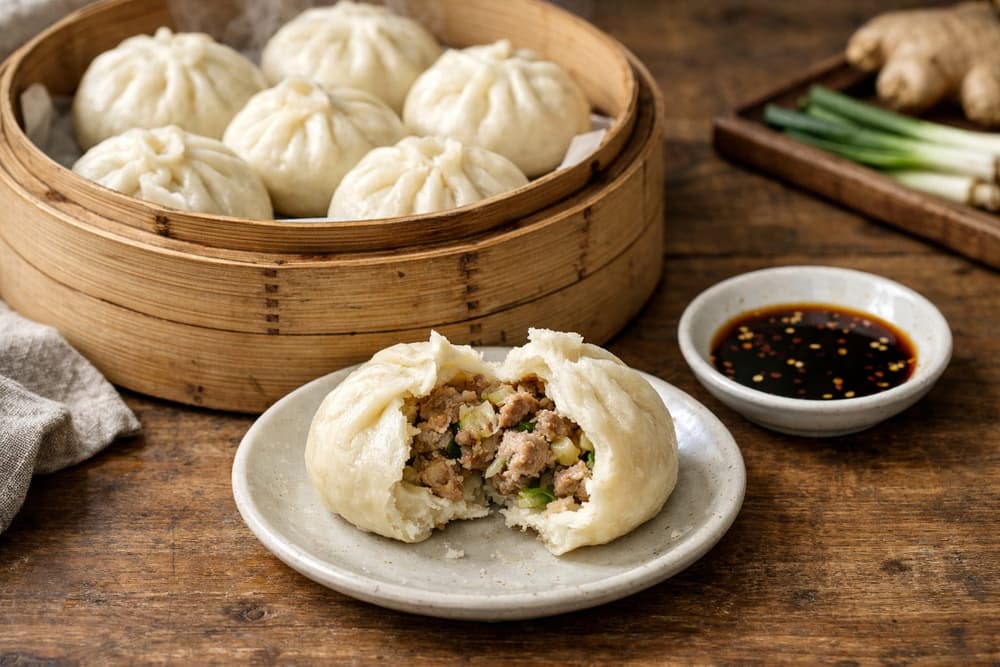
Baozi from scratch: a firm yeast dough filled with ground pork and napa cabbage, pleated and steamed for 15 minutes. Makes 12 buns, with freezing notes.
- Total
- 2 hr 20 min
- Serves
- 12
- Calories (est.)
- 170
Baozi are Chinese steamed buns: a soft yeast dough wrapped around a filling and cooked in steam. This recipe makes twelve with a filling of ground pork, napa cabbage, scallions, ginger and soy sauce. The dough rises for an hour, each bun is pleated shut by hand, and a batch steams in 15 minutes.
What baozi are
Wikipedia describes baozi, or simply bao, as a yeast-leavened filled bun found in various Chinese cuisines, with meat or vegetarian fillings, most often made from wheat flour and steamed. The article calls them a variation of mantou from northern China. By the Qing dynasty, it says, the two words had settled into their present meanings: baozi are buns with fillings, mantou are steamed buns without.
The same article notes that baozi can be eaten at any meal and are often eaten for breakfast.
Pork with cabbage, the filling in the card, is one of many. The dough and the method stay the same for the others.
Recipe
Baozi (Steamed Pork Buns)
Chinese steamed buns from a firm yeast dough, filled with ground pork, napa cabbage, scallions, ginger and soy sauce. Twelve buns.
- Prep
- 45 min
- Cook
- 15 min
- Total
- 2 hr 20 min
- Serves
- 12
- Cuisine
- Chinese
Ingredients
- For the dough:
- 2 1/2 cups all-purpose flour
- 1 tablespoon granulated sugar
- 1 teaspoon instant yeast
- 1/4 teaspoon salt
- 2/3 cup lukewarm water
- 1 tablespoon vegetable oil
- For the filling:
- 1 1/2 cups finely chopped napa cabbage
- 1/2 teaspoon salt
- 8 ounces ground pork
- 2 scallions (finely chopped)
- 1 tablespoon soy sauce
- 2 teaspoons oyster sauce
- 2 teaspoons Shaoxing wine (or dry sherry)
- 1 teaspoon toasted sesame oil
- 1 teaspoon grated fresh ginger
- 1 clove garlic (finely chopped)
- 1 teaspoon cornstarch
- 1/8 teaspoon ground white pepper
- 1 tablespoon water
Instructions
- Stir the flour, the sugar, the yeast and 1/4 teaspoon of salt together. Add the lukewarm water and the oil and mix to a rough dough. Knead for 8 to 10 minutes, until smooth and no longer sticky. Cover and let rise for 1 hour, until doubled.
- Toss the cabbage with 1/2 teaspoon of salt and let it stand for 10 minutes. Squeeze it firmly in a clean towel until no more liquid comes out.
- Stir the pork with the soy sauce, the oyster sauce, the wine, the sesame oil, the ginger, the garlic, the cornstarch, the white pepper and 1 tablespoon of water in one direction for 2 minutes, until sticky. Stir in the cabbage and the scallions.
- Knead the risen dough briefly to press out the air and roll it into a rope. Cut it into 12 equal pieces. Roll each into a 4-inch round that is thinner at the edge than in the middle.
- Put a heaped tablespoon of filling in the middle of a round. Pleat the edge all the way around, gathering it over the filling, and pinch the top shut. Set each bun on a square of parchment paper.
- Cover the buns and let them rest for 20 minutes, until slightly puffed. Bring 2 inches of water to a boil in a pot or wok that the steamer fits.
- Steam the buns over medium heat for 15 minutes, 1 inch apart, in batches if needed. Turn off the heat and wait 5 minutes before lifting the lid.
Nutrition
- Calories:
- 170
Calculated from the ingredient quantities above using the USDA FoodData Central database, then divided by the number of servings. It is an estimate and will vary with the exact products you use.
Baozi dough: firm, smooth, not sticky
By weight the dough is about 300 grams of flour to 160 grams of water, which is drier than a bread dough. That is intended. A firm dough holds its pleats and does not spread in the steamer. It feels stiff for the first minutes of kneading and turns smooth after eight to ten.
- If it will not come together, add water a teaspoon at a time.
- Knead until the surface is smooth. A rough dough steams into a pitted bun.
- After shaping, the buns rest for only 20 minutes. Buns that rise too long collapse and wrinkle when the lid comes off.
The pork and cabbage filling
Cabbage is mostly water. Salted and squeezed, it gives that water up before it goes into the bun. Unsalted, it gives it up in the steamer, and the bottom of the bun turns soggy.
Stirring the meat in one direction until it is sticky binds the filling, so that it holds together as one piece inside the bun.
Other fillings for the same dough are ground chicken with chopped shiitake mushrooms, or cooked greens with firm tofu and a teaspoon of sesame oil. Keep to a heaped tablespoon a bun.
Pleating, and the shortcut
Hold the round in one hand with the filling in the middle. With the other hand, pinch a small fold at the edge, make the next fold beside it and press it onto the first, turning the bun as you go. Twelve to fifteen folds close the circle; pinch the top together.
The shortcut: gather the edge like a pouch, pinch it shut and set the bun seam side down. It steams the same way.
Steaming without a bamboo basket
A metal steamer insert or a colander set over a pot works. Wrap the lid in a kitchen towel so that condensation does not drip onto the buns. Keep the water at a steady simmer and leave an inch between the buns, because they grow by about half.
The five minutes of waiting at the end let the buns cool gradually. A rush of cold air on a hot bun makes the skin collapse.
Dipping, freezing, reheating
For dipping, mix soy sauce with a little rice vinegar and chili oil, or use the P.F. Chang's lettuce wrap sauce, which is built on the same two.
Steamed baozi can be frozen: cool them, freeze them on a tray and bag them. They keep two months and steam from frozen in 8 to 10 minutes. In the microwave, cover a bun with a damp paper towel and heat it for 45 to 60 seconds.
Another yeast dough on this site is the King Arthur sandwich bread, and a Chinese-American restaurant dish is the P.F. Chang's sweet and sour chicken.
Did you make this?
Let others know how it turned out.